Stands for: Direct Hair Implantation
Approach: Doctor-Led
Cost: £4,000 – £8,000+
Finance Available




Stands for: Direct Hair Implantation
Approach: Doctor-Led
Cost: £4,000 – £8,000+
Finance Available
Every procedure at Hair Transplant Liverpool is carried out by a doctor on the GMC register
Our clinic is centrally located and accessible from across Merseyside, Cheshire, and beyond
A candid assessment of your donor area and realistic expectations, no targets, no sales pitch
From the first follicle extracted to the final graft placed, your surgeon is present throughout
If you have already read about FUE and are wondering whether DHI is worth considering instead, this is the page that will help you decide. Both techniques are available at our Liverpool clinic. Both use identical donor extraction. The difference comes down to how grafts reach the scalp, and in most cases that difference is smaller than the marketing around DHI suggests. But in specific situations, it is the right call.
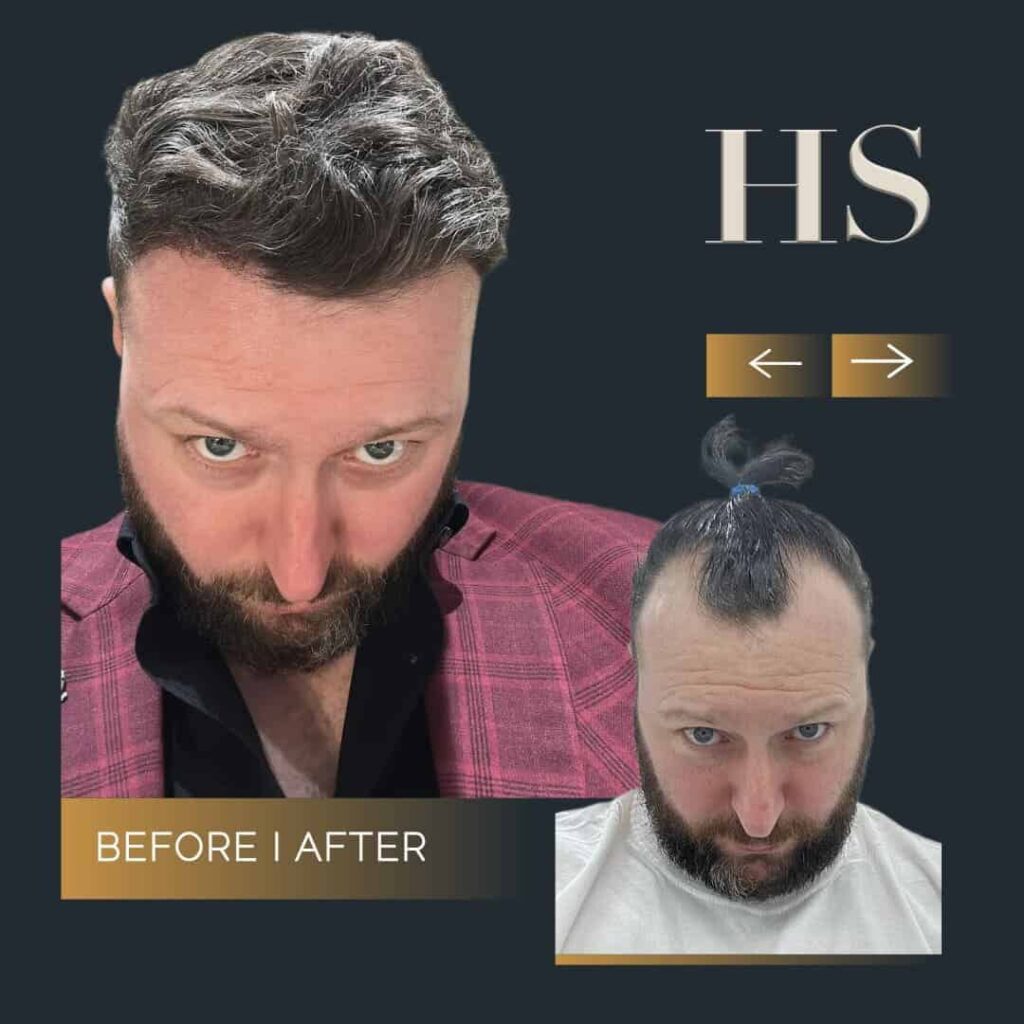
DHI, Direct Hair Implantation, uses a device called the Choi Implanter Pen to place each graft at the moment of incision rather than after a pre-made channel. It is a precision instrument, and for the right case it offers genuine advantages. For other cases, standard FUE achieves equivalent outcomes at a lower cost and with less implantation time per session.
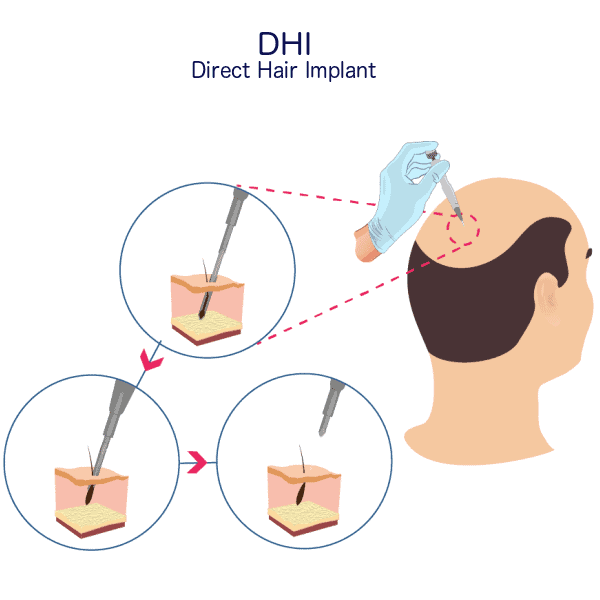
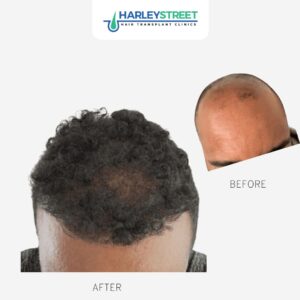
A selection of results from patients treated at our Liverpool clinic. All procedures were performed by our GMC-registered surgeons.
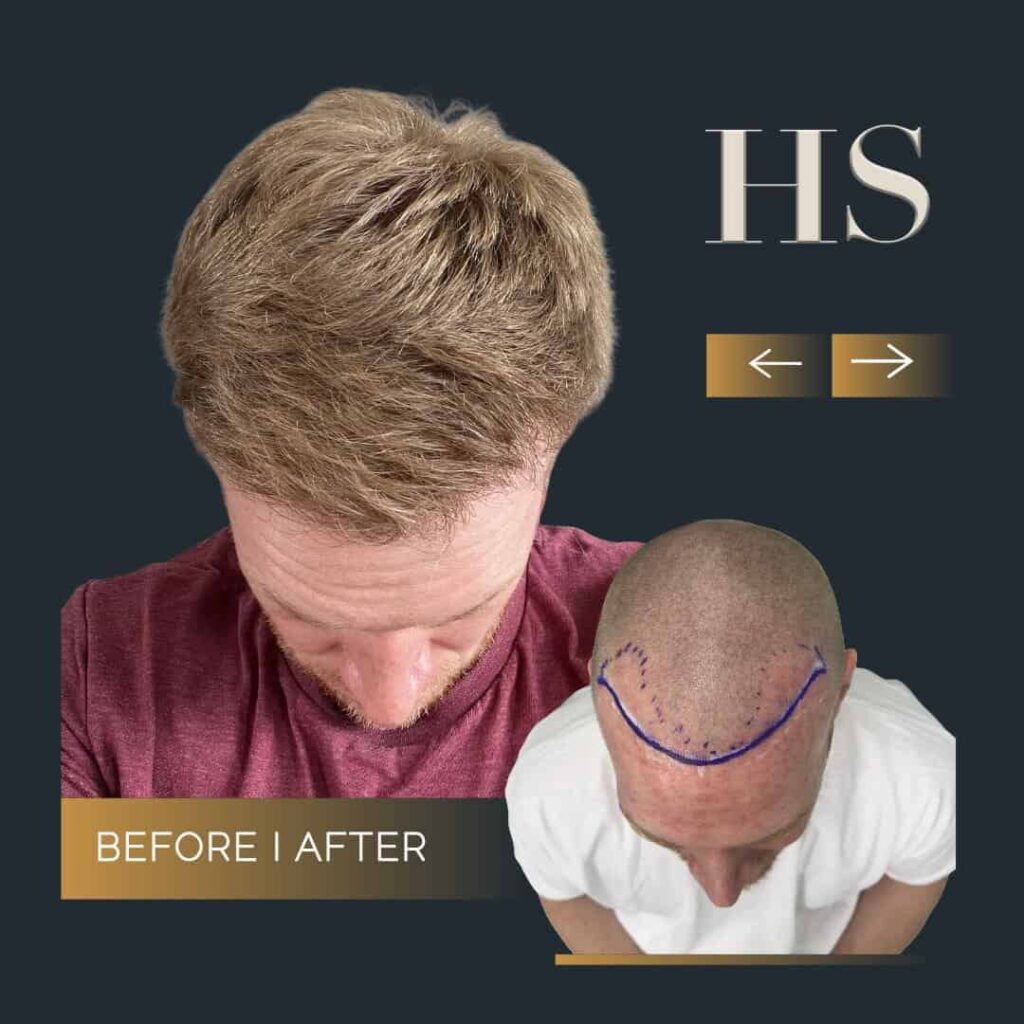
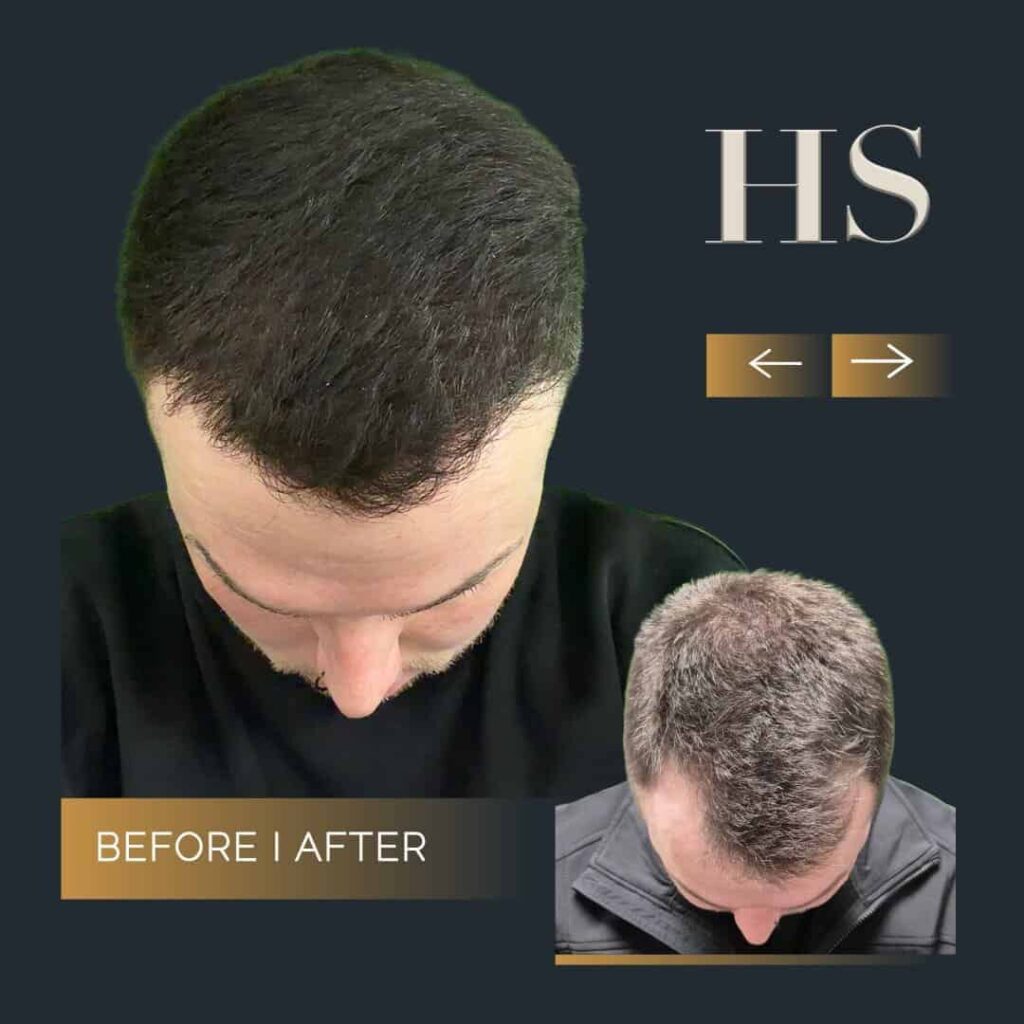
A selection of patient results from our Liverpool DHI procedures.
In standard FUE, the surgeon makes recipient incisions across the scalp first, then places grafts into those channels as a separate step. There is a period, sometimes up to an hour in a large session, where the channels are open and waiting. With DHI, the Choi pen eliminates that gap entirely: incision and placement happen in a single motion.
What most descriptions get wrong is who loads the pen. At our Liverpool clinic the loading is done by technicians, not the surgeon. During the implantation phase, two to three technicians work on a rotation alongside the surgeon. Each technician takes a used pen from the medical trolley, carefully loads a single extracted follicle into the hollow needle, and returns the loaded pen to their side of the trolley. The surgeon takes one loaded pen at a time, positions the sharp tip at the correct angle and depth in the recipient area, depresses the plunger to deposit the follicle, then sets the pen down on the opposite side of the trolley. That pen is immediately picked up by a technician to be reloaded. The surgeon picks up the next loaded pen from the other side and repeats.
With roughly three pens in rotation at any given time, the surgeon is never waiting for a loaded pen and the technicians are never idle. This rhythm is what allows DHI to maintain placement precision at a pace that is clinically practical. Each follicle spends minimal time outside the scalp, and every graft is placed at the exact angle and depth the surgeon intends.
The practical benefit is twofold. First, follicle handling time is reduced: each graft goes from extraction to scalp faster, which is beneficial for graft survival. Second, the angle and direction of every graft is set at the moment of placement, giving the surgeon granular control over growth direction — particularly valuable at the hairline, where leading-edge hairs need to lie almost flat against the skin.
The limitation is throughput. The pen rotation system, while efficient, means DHI sessions run longer than standard FUE for the same graft count. The technique is less suited to very large sessions covering extensive areas in a single day.
DHI is widely described as if it is a separate procedure from FUE. It is not. The two terms describe different phases of the same operation, and understanding this distinction is important when comparing clinics.
FUE — Follicular Unit Extraction — describes the extraction phase: individual follicular units are removed from the donor area one at a time using a micro-punch device. The donor area must be shaved before extraction can begin, because the punch needs to be positioned precisely around each follicle at skin level.
DHI — Direct Hair Implantation — describes only the implantation phase: the method by which extracted grafts are placed into the recipient area using the Choi pen rather than pre-made channels.
A DHI procedure therefore always includes FUE. The donor area is shaved, the grafts are extracted by FUE with the micro-punch, and then those grafts are implanted directly using the Choi pen. There is no version of DHI that bypasses the FUE extraction stage. When a clinic markets DHI as an entirely different technique to FUE, they are either misunderstanding the procedures or misrepresenting them.
The no-shave option that is sometimes offered applies to the recipient area only — the top of the scalp where hair is being added. In that case, existing hair in the recipient zone is not shaved, which is what allows DHI to add density into an area that still has some coverage. The donor area at the back and sides must still be shaved for extraction to take place.
There are three situations where DHI is the stronger recommendation at our Liverpool clinic. The first is patients adding density into existing hair, where the recipient area already has some coverage and shaving is either impractical or something the patient wants to avoid. The pen allows placement between existing hairs without disrupting them in the way pre-made channels might.
The second is maximum density in a confined zone. For a small crown patch or a tight temple zone, DHI allows more grafts per square centimetre without the risk of slitting channels too close together before grafts go in. The third is patients with particularly fine or fragile hair, where reduced handling time meaningfully improves graft survival.
For most patients covering a standard hairline recession or the frontal third of the scalp, standard FUE delivers the same result. If you are unsure, the surgeon will tell you directly at consultation which approach fits your presentation. If DHI does not add meaningful value for your case, it will not be recommended.
The day follows the same structure as FUE. Morning consultation and design, donor preparation and anaesthetic, extraction phase, a short break, then implantation using the Choi pens. The total time runs slightly longer than a comparable FUE session for the same graft count, typically nine to eleven hours. Aftercare is identical: elevated sleep, no direct water over the scalp for five days, no exercise for two weeks.
Our surgeons perform every extraction and every Choi pen placement personally. There is a single surgeon assigned to your procedure for the full day. Technicians handle graft loading and non-clinical support tasks, but clinical decisions remain with the operating doctor throughout.
DHI demands a higher level of per-graft precision than standard FUE. The Choi implanter pen loads and places each follicle in one action, which shortens the time grafts spend outside the scalp. The result depends entirely on surgical control — here is why that matters at our clinic.
Each graft is loaded into the Choi pen and placed immediately without a separate channel-cutting stage. Out-of-body time is the primary variable affecting graft survival. Shorter handling means more follicles arrive in viable condition.
The implanter pen allows precise angle and depth per graft, but the precision is only as good as the surgeon using it. Every incision direction is set to mirror your existing hair pattern. No template. No automation.
DHI can achieve slightly higher packing density in targeted areas because simultaneous channel-cutting and placement reduces tissue trauma in the recipient zone. This is particularly relevant for hairline work where density expectations are highest.
Not every patient benefits from DHI over FUE. If the yield difference is marginal for your specific case, your surgeon will say so. The choice of technique follows clinical assessment, not marketing preference.
What to expect after your procedure, week by week and month by month.
DHI recovery in the first five days closely follows standard FUE aftercare. The recipient area requires dry conditions, elevated sleeping position, and no touching or scratching. Swelling in the forehead and around the eyes typically peaks on days two and three. On day five, your surgeon will clear you to begin gentle washing with the technique demonstrated at discharge. Because no separate channel-cutting was performed, tissue trauma in the recipient area is typically lower than with conventional FUE.
Transplanted hair sheds between weeks two and six. This is a normal part of the follicular resting cycle. The follicle itself is undisturbed. Avoid heavy physical exercise, gym use, and direct sun exposure for the first three weeks. The donor area heals quickly with DHI due to the small circular dot marks, typically allowing return to non-contact sport by week three.
New hair growth begins around the three to four month mark and accelerates significantly from month six. The final density assessment is most accurate at twelve months, when the growth cycle has completed a full round. Most patients see between seventy and ninety per cent of their anticipated density by nine months.
DHI procedures are priced slightly above equivalent FUE sessions, reflecting the additional instrument time involved in individual pen placement. A moderate hairline or density session typically starts from £4,000 to £4,500. Larger procedures are quoted individually at consultation based on the graft count and surface area involved. Finance is available. Your initial assessment is free.
Make the best investment in yourself and find out more about how we can help eliminate hair loss for good!
Our Liverpool clinic is at Exchange Flags in the city centre, a short walk from Liverpool Lime Street and Liverpool Central stations.
Hair Transplant Liverpool
Horton House, Exchange Flags,
Liverpool, L2 3PF
Queen Square Bus Station is also nearby. There is no on-site parking, but several multi-storey car parks are within a five-minute walk. Appointments are required.
Yes, modestly. The additional precision time involved in individual Choi pen placement adds to the overall procedure cost. Whether that premium is justified depends on your specific case, which the surgeon will assess at consultation.
In many cases, yes. One of DHI’s practical advantages is that placement into existing hair can be done without shaving the top of the scalp. The donor area at the back still needs to be shaved for extraction. This makes DHI appealing for patients with longer hair on top who want to minimise visible changes during the recovery period.
Healing follows the same timeline as FUE. Crusting resolves in seven to ten days, transplanted hair sheds between weeks two and six, and new growth starts around month three. Final density at twelve to eighteen months.
Neither is universally better. DHI is better than FUE in specific clinical situations. FUE is more efficient for large sessions and broadly equivalent for standard hairline and mid-scalp work. The surgeon will tell you which is appropriate for your case.
Typically 1,500 to 2,500 grafts per day. Very large sessions above 3,000 grafts are generally better suited to standard FUE, where throughput is higher. Where very high graft counts are needed, a staged approach may be recommended.
The consultation happens before any commitment to a technique. If standard FUE achieves the same result for your case, the surgeon will explain why and quote accordingly. You are never obligated to proceed with a technique or a price you did not agree to.
Aside from achieving fantastic results, we believe that keeping in touch with our patients before, during and after their hair transplantation procedure is paramount – it helps to keep our patients feeling calm and in control. We’re always on hand to provide guidance, support and aftercare advice. Time and again, our patients tell us that this is what sets us apart from other clinics.
You can read our great reviews of FUE hair transplants over on Google and Trustpilot